
Robots need to move their arms, legs, hands, and other parts smoothly and accurately. However, the electric motors inside robots often spin much faster than these movements require. This is where a robotic gear reducer comes in.
A gear reducer is a mechanical device that reduces motor speed and increases the available turning force, known as torque. It helps robots lift objects, support loads, and perform controlled movements.
In this beginner-friendly guide, we explain what gear reducers do, how they work, the three common types used in robotics, and what to consider when selecting one.
Why Do Robots Need Gear Reducers?
Imagine riding a bicycle uphill. When you change to a lower gear, the wheels turn more slowly for each pedal rotation, but climbing becomes easier.
A robotic gear reducer works on a similar principle. A motor may spin very quickly but provide relatively little turning force. A reducer changes this relationship, allowing the robot to move more slowly with greater torque.
Simple explanation: A motor provides rotation. A gear reducer helps turn that rotation into the speed and turning force needed by a robot.
How Does a Gear Reducer Work?
Inside a gear reducer are mechanical components that transfer rotation from the motor to an output shaft. By using different gear arrangements, the reducer produces a lower output speed.
The relationship between input speed and output speed is called the reduction ratio.
For example, a reduction ratio of 10:1 means the motor turns ten times for every one rotation of the reducer’s output shaft.
Input
Ratio
Speed
A reducer does not create extra energy. It exchanges speed for torque, with some energy lost through friction and heat.
This is why a relatively small motor can be paired with an appropriate reducer to move a robotic arm or joint.
Is a gear reducer the same as a robot joint module? Not exactly. A gear reducer is a transmission component. An integrated robot joint module may combine a motor, reducer, encoder, housing, and sometimes a driver or brake into one assembly.
Three Common Types of Robotic Gear Reducers
Not all gear reducers work in the same way. Different mechanical designs are used to meet different requirements for torque, accuracy, size, weight, and durability.
Three common types used in robotics are planetary, harmonic, and cycloidal gear reducers.
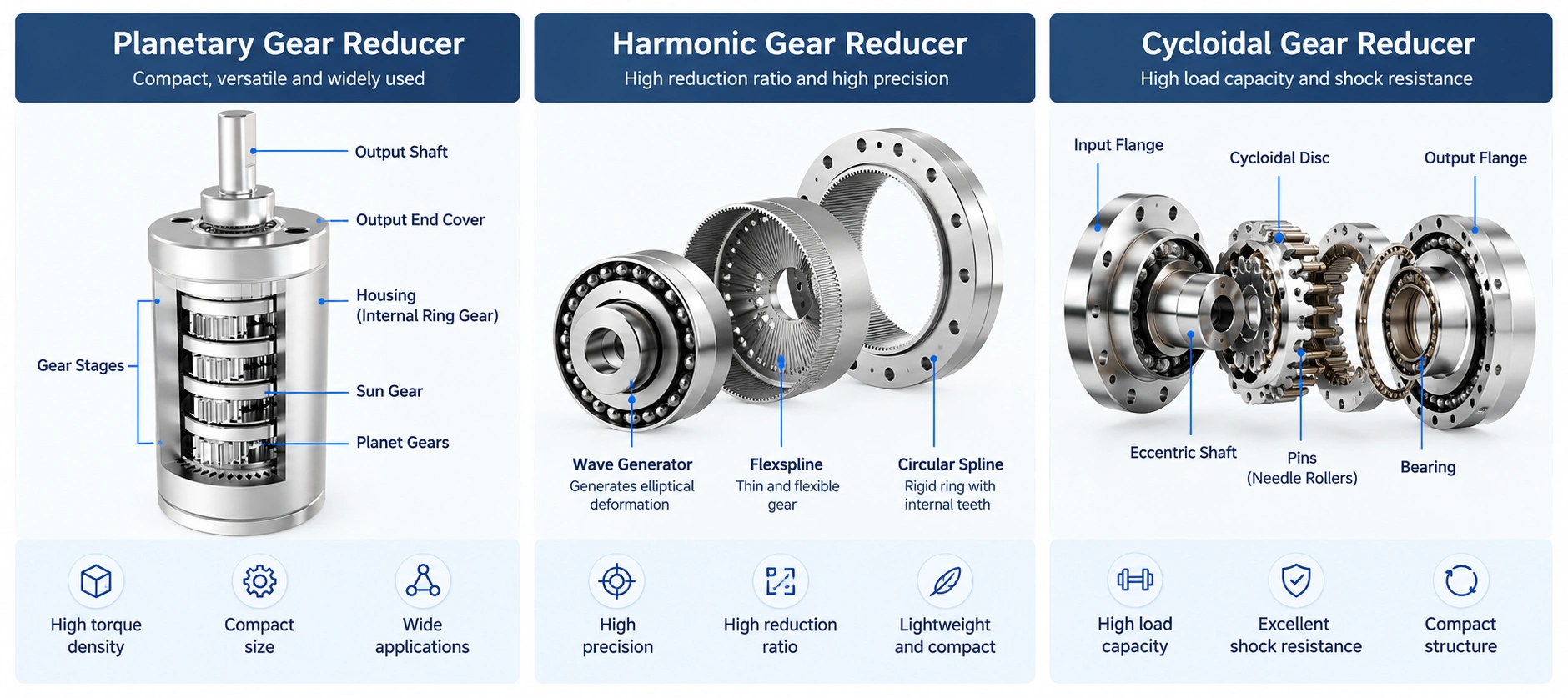
Planetary Gear Reducer
A planetary reducer uses a central sun gear, smaller planet gears, and an outer ring gear. These gears work together to transmit rotational movement.
Planetary reducers are popular because they can provide a compact design, useful torque capacity, and a wide range of reduction ratios.
Harmonic Gear Reducer
A harmonic reducer, also called a strain wave reducer, uses a wave generator, a flexible gear called the flexspline, and a rigid circular spline.
This design can provide a high reduction ratio in a compact space with very low backlash, making it useful for precise movements.
Cycloidal Gear Reducer
A cycloidal reducer uses specially shaped discs driven by eccentric motion. The discs work with pins or rollers to transmit torque.
Cycloidal mechanisms can be designed for high load capacity and resistance to sudden forces or impacts.
Quick Comparison
| Type | General Strength | Typical Applications |
|---|---|---|
| Planetary | Compact, versatile, and available with many reduction ratios. | Joint modules, automation systems, and mobile robots. |
| Harmonic | High reduction ratios and very low backlash. | Robot arms, wrists, and precision joints. |
| Cycloidal | High load capacity and good shock resistance. | Industrial robot joints and high-load applications. |
There is no single best reducer for every robot. The right choice depends on the specific model, the required performance, and the application.
Where Are Gear Reducers Used in Robots?
Gear reducers are used in many kinds of robots. Their job is to help convert motor rotation into practical, controlled movement.
Humanoid Robots
Gear reducers help control movements in the shoulders, elbows, hips, knees, and other rotating joints.
Robotic Arms
Reducers help robotic arms position tools, lift objects, and repeat movements accurately.
Quadruped Robots
Four-legged robots use geared actuators in their legs to support walking, turning, and balancing.
Industrial Automation
Gear reducers are used in rotary axes, automated positioning equipment, and other motion systems.
How to Choose the Right Gear Reducer
You do not need to understand every mechanical detail to begin selecting a reducer. Start with five simple questions.
How Much Turning Force Is Needed?
A robot lifting a heavy object generally needs more output torque than one moving a small, lightweight part.
How Fast Should It Move?
The reduction ratio helps determine how fast the output turns relative to the motor.
How Accurate Must the Motion Be?
Low backlash can help reduce unwanted movement when a joint changes direction.
How Much Space Is Available?
A compact robot joint may need a reducer that fits within strict size and weight limits.
How Often Will It Operate?
Continuous operation, repeated movements, and sudden loads affect heat generation and durability requirements.
Consider the Complete System
A reducer should be selected together with the motor, mounting structure, expected load, and application.
Remember: The best gear reducer is not necessarily the strongest or most expensive. It is the one that matches the robot’s actual movement and operating requirements.
Small Components, Important Functions
A robotic gear reducer may be small, but it plays an important role in how a robot moves.
By reducing motor speed and increasing available torque, it helps robots lift, rotate, walk, and perform controlled movements.
Planetary, harmonic, and cycloidal reducers each offer different advantages. Understanding these basic differences is a useful first step toward selecting the right motion components for a robot.
Looking for a Gear Reducer for Your Robot?
ARTUS provides precision gear reducers, robot joint modules, and engineering support for robotic and industrial automation applications. Share your torque, speed, reduction ratio, and installation requirements with our team.